
New ASFA research reveals that half of adults have consulted any source of information about their retirement. In this article, ASFA’s Economic Specialist Andrew Craston, explores the findings and why expanding access to affordable, trusted advice through super funds is critical to improving retirement outcomes.
Most Australians enter the compulsory superannuation system with their first adult job. But for many, meaningful engagement with their super does not happen until much later in life.
ASFA’s research shows that only half of all Australians aged over 18 have consulted any source of information about retirement. While that share rises somewhat with age, it means that many Australians approaching retirement are making decisions with little to no guidance.
Trusted sources of advice are difficult to access
Compared with ASFA’s 2024 survey, reported use of formal information sources has declined, while Australians are making greater use of informal sources such as friends, family and media articles.
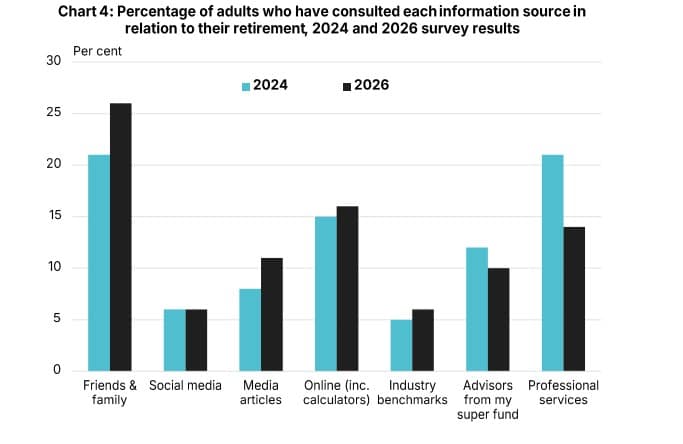
However, the sources Australians use are not necessarily the ones they trust.
Across all age groups, the most trusted sources of information are professional advice services (financial advisers), advisers provided by super funds, and industry benchmarks such as the ASFA Retirement Standard.
Social media is consistently the least trusted source. People aged 18 to 34 are 11 times more likely than those aged over 65 to consult social media for information about retirement, despite social media ranking as Australians’ least trusted source of retirement information across every age group.
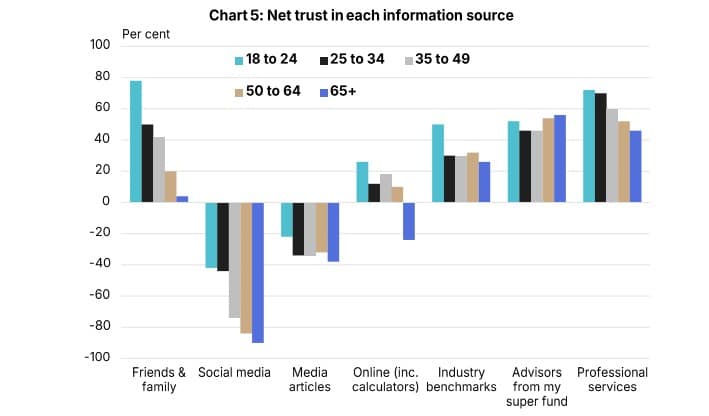
The clearest disconnect is advice provided through super funds. Australians of all ages place a high degree of trust in fund advisers, but their services remain underused until people approach or enter retirement.
The findings suggest that trust is not the central problem. Barriers such as cost, awareness and accessibility are preventing Australians from using the sources of advice they value most.
How much super is enough?
The amount of superannuation needed for retirement depends on a range of individual circumstances, including:
- The expected age of, and duration of, retirement
- The desired standard of living
- Access to other sources of retirement income other, such as the Age Pension and private savings
It’s therefore unsurprising that Australians’ estimates vary widely.
Estimating the superannuation needed for retirement is complex, with key factors including life expectancy, household spending and income sources beyond super.
Confidence in estimating retirement needs generally increases with age. However, younger Australians consistently estimate they will need more super than older Australians, suggesting age-related factors are at play.
This may reflect expectations of greater financial pressures, including higher housing costs, lower home ownership rates and later entry into the property market. As a result, younger Australians may expect to rely more on super to pay off mortgages or cover rental costs in retirement.
Another age-related factor is knowledge of how superannuation works.
While 66 per cent of respondents say they know either “nothing”, “not much” or only “a little” about super, understanding generally increases with age. Younger Australians are therefore also likely to have a more limited understanding of the broader retirement income system, including the role of the Age Pension.
The wide range of estimates for the super needed at retirement highlights the need for better education and advice. This is particularly important for younger Australians, whose higher retirement savings estimates are coupled with lower levels of superannuation knowledge.
The ASFA Retirement Standard remains a relevant reference point for the super needed for a comfortable retirement. Most respondents across every age group nominated an amount consistent with, or greater than, the balances needed to support a comfortable retirement under the Standard.
Fewer advisers are serving more people with superannuation
The research also shows that the number of licensed financial advisers is around 40 per cent lower than a decade ago, while the number of Australians with a super account is around 20 per cent higher over the same period.
Arguably the value of good advice is greatest for younger Australians, who have the most time for decisions to compound. For a 30-year-old on average wages, an extra quarter of a percentage point in annual investment returns means around $40,000 more at retirement. For a 50-year-old, the same difference is worth about $7,000.
Closing the advice gap
The research findings strengthen the case for progressing advice reforms, through Tranche 2 of the Delivering Better Financial Outcomes (DBFO) package, as a priority.
The reforms are designed to widen access to low-cost, trusted advice through superannuation funds by:
- Allowing funds to send targeted superannuation prompts, or nudges, to members at key moments
- Expanding low-cost, collectively charged advice on a defined set of topics through members’ own funds
- Introducing a new class of advisers to lift the overall supply of advice
Together, these measures would enable more advice to be delivered through trusted institutions, including APRA-regulated super funds.
Additionally, the Government is considering proposals to update the education requirements for new financial advisers, which will encourage people to join the profession, as outlined in their recent consultation paper on the matter.
Expanding access to trusted advice
Financial advice is crucial to both help everyday Australians make informed choices about their financial future, and to protect them from unnecessary financial harm.
Australians place a great deal of trust in advice provided through their super fund, yet current policy settings make that advice difficult and expensive to deliver. Simplifying the super system and removing barriers to trusted, fund-based advice would make it easier for more Australians to access the support they need.
For further information, read ASFA’s Survey on superannuation: Advice and other information sources on retirement paper.