
The Government is reviewing the superannuation performance test to ensure it remains fit for purpose. ASFA supports retaining its core role of ensuring members are seeing strong financial returns, but the current review gives an opportunity to modernise the test.
In this article for ASFA News & Insights, ASFA’s Chief Policy & Advocacy Officer James Koval explains how the framework must now evolve to reflect today’s investment environment to allow for greater investment in emerging asset classes such as housing, energy, private equity and infrastructure, while continuing to support strong member returns.
What is the superannuation performance test?
Launched on 1 July 2021, the annual superannuation performance test assesses whether superannuation products are delivering strong outcomes for members by benchmarking investment performance across a range of asset classes. This has a significant influence on how funds design and allocate their investment portfolios.
The policy aimed to protect disengaged members, who may have unknowingly remained in underperforming superannuation options. In a compulsory superannuation system, poor returns are not acceptable, and five years on from the test’s introduction, we’ve now seen funds consistently outperforming for members.
The performance test was originally introduced to measure fund performance using a range of ‘benchmarks’.
For example, super funds diversify their investments across the ASX, international stock markets like the NASDAQ and other asset classes which are relatively straightforward to measure year-on-year. However, funds also undertake significant direct investment in assets such as infrastructure, property, and energy. In recent years, as funds have grown in both size and sophistication, these direct investments have become an increasingly important part of their portfolios.
Why is the performance test being reviewed?
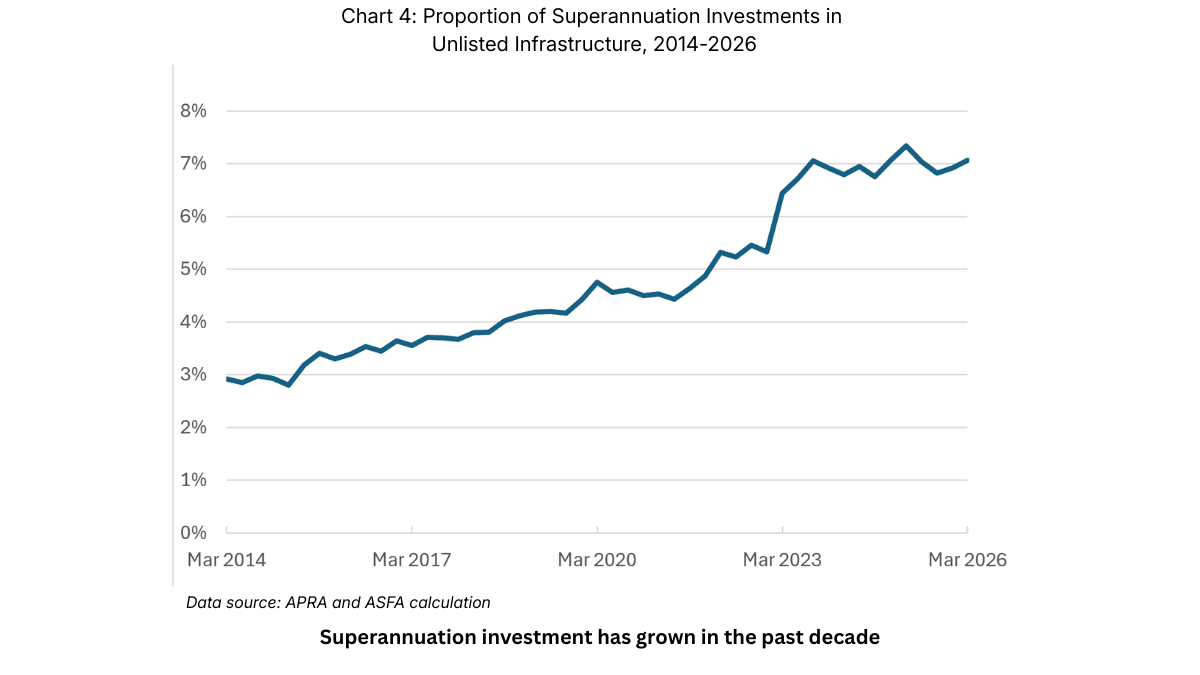
Some shortcomings of the test became apparent soon after it was introduced. While it provided a helpful reference point on performance for individual members, it also resulted in restricting investment in long-term assets and non-public assets – such as infrastructure, energy and housing.
These are relatively illiquid assets with very long investment horizons that do not always fit neatly with a yearly performance test.
While public markets such as the ASX have relatively clear benchmarks that make it easy to compare a fund’s performance, establishing comparable benchmarks for other assets, such as Australian commercial property or emerging asset classes like renewable energy, housing and data centres is more challenging. Annual benchmarks are less meaningful for these investments, particularly if the investment horizon spans a decade or longer.
For that reason, concerns were raised about the way the test can restrict investment.
It is also important to note that since the test’s introduction, many of the issues that prompted its creation have now reduced. Superannuation fund numbers have halved over the past five years through consolidations while members have also seen double-digit returns in recent years.
The performance test has increasingly been seen as a barrier to productive investment by super funds, and requires modernisation.
The government shares this view.
What is Treasury considering about the performance tests?
In August 2025, the government convened the Economic Reform Roundtable bringing together representatives from across the economy to explore ways to uplift productive investment and other measures to improve productivity.
Representing the super sector, ASFA helped shape discussions that resulted in broad acknowledgement that the existing design of the performance test is a barrier to productive investment in the economy.
In November 2025, Treasurer Jim Chalmers, speaking at ASFA’s National Conference, outlined that the government would undertake changes to the performance test. The government’s objective was to ensure that the test remains an important comparison benchmark for individual members of the community, while also ensuring that any changes are enduring while removing investment constraints.
A consultation process was then undertaken, which has recently closed for comment. That process sought the views of the sector on whether the test is acting as a barrier and what needs to change.
ASFA proposes 3 changes to the performance test
In response to the government’s request for comment, ASFA has put forward three main changes on behalf of the sector.
1. Add an emerging assets subsection to the existing test design
ASFA supports a modernisation of the test that keeps the strengths of the current benchmark framework. There are many investments that can be tracked and measured relatively easily, and that part of the test should be maintained.
While retaining the existing test design, the superannuation sector supports the creation of an emerging assets subsection for investments such as housing, energy, private equity and infrastructure.
Rather than measuring these assets against benchmarks that are difficult to identify, this approach would ensure that funds are providing returns above inflation to their members. This would reduce barriers to investment, still ensure good returns to members, and maintain the aspects of the test that work well.
2. ASFA supports an expansion of the test’s coverage
Currently, the performance test covers only a small fraction of products in the market, with a particular focus on choice and default products. ASFA supports expanding the test to cover all trustee-directed products, particularly as more Australians consider their options and look at products available on platforms.
3. ASFA supports a review of the benchmarks to ensure they remain fit for purpose
The current benchmarks do not adequately capture private market opportunities or ESG opportunities. There would be merit in giving the prudential regulator, APRA, greater flexibility to make updates in consultation with sector experts where appropriate.
This would help ensure that benchmarks are more transparent, more current and more useful.
In summary, the sector supports three areas of reform: reducing investment barriers in areas that matter, while still ensuring the test remains a strong consumer tool; expanding the coverage of the test; and future-proofing the benchmark framework so that it remains enduring.
Modernising the performance test: Treasury will now consider the next steps
There is a clear and united sector position on this issue, and ASFA hopes to see progress.
The next step is for Treasury to release the government’s position based on industry feedback on the performance test. This should include a proposed pathway for changes to regulations and to the design of the test.
ASFA will continue work to through any technical implementation issues that may arise, but are hoping to see strong progress in the coming months.
ASFA provided a submission in response to the Treasury consultation on Strengthening the Superannuation Performance Test. You can read this on the ASFA website here.
The performance test is one of the topics to be discussed at the ASFA Policy Roadshows in Sydney on 21 July and Melbourne on 22 July. Visit the website for further information and to register.